
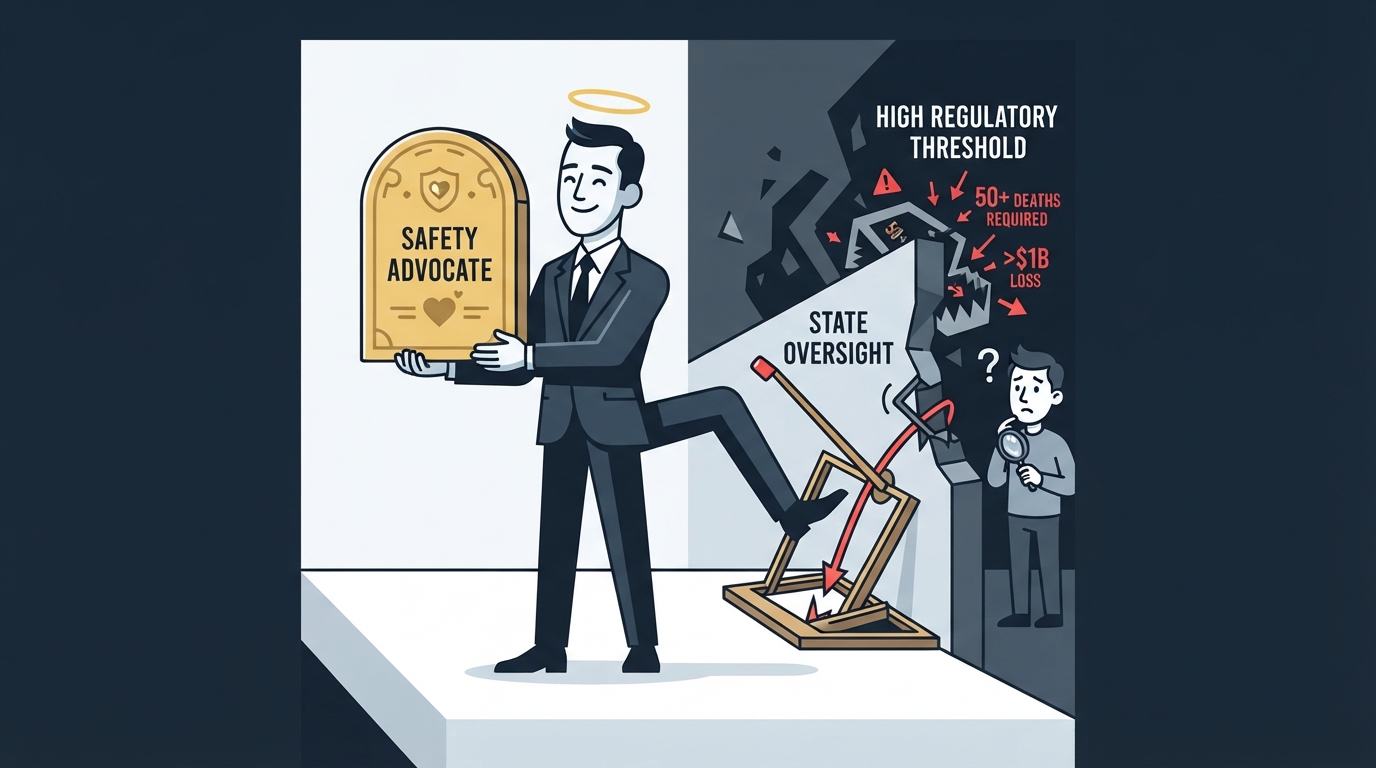
Yesterday, the public debate between regulatory expert Nathan Calvin and Anthropic CEO Dario Amodei became a hot topic.
It started because Anthropic had always presented itself as safety-first, yet it privately submitted a draft bill to Congress seeking to use a federal preemption clause to abolish state regulatory authority and set an extremely high threshold for the government to halt dangerous AI—it would have to prove that the AI was imminently likely to cause death or serious injury to more than 50 people, or more than $1 billion in losses.
Nathan, a core drafter of the California bill, caught Anthropic red-handed in this trick of publicly parading its virtue while secretly sabotaging others.
In the debate, Nathan posed the pointed question: why is it that every single one of your “mistakes,” without exception, systematically benefits your own commercial interests?
Well, this adds yet another entry to my “fine words on the lips, business in the pocket” series.
When Dario left OpenAI with his team back then, the image he projected to the outside world was that of a safety guardian indifferent to fame and fortune.
But the evidence Nathan threw out stripped Anthropic bare: it was not only preparing an IPO plan at a $2 trillion valuation and signing a $500 billion compute procurement agreement, but also secretly submitting a draft bill to Congress in an attempt to use federal provisions to directly override states’ authority to regulate dangerous AI.
Faced with these accusations, Dario readily admitted in his reply that some things had been handled improperly, then promptly shifted the blame to the “big-company disease” of a 5,000-person organization, saying these were communication breakdowns and occasional “missteps” during organizational expansion.
The details are as follows:
| Dario’s occasional missteps | Actual operation | Commercial interest |
|---|---|---|
| Privately slipping a bill to Congress was an “internal communication lapse” | Pushing a federal preemption clause in the draft and setting an extremely high threshold for halting AI | Abolishing states’ independent regulatory authority and preventing its own models from being halted by the government |
| Modifying core safety policy was “to avoid rigid rules” | Unilaterally abandoning the commitment to “pause development when safety cannot be proven” | Dismantling self-restraint to ensure commercial iteration does not fall behind |
| Writing to Congress to explain AI attack behavior was “poorly worded” | Characterizing the incident of Claude attacking users as a mere configuration issue | Covering up the risk of model alignment failure and avoiding legislative accountability |
After reading these so-called “mistakes,” any clear-eyed observer can see the trick inside.
If a company of Anthropic’s valuation really suffered from communication breakdowns as easily as Dario says in its daily operations, then probabilistically the direction of its mistakes should sometimes cut against it and sometimes in its favor, and the probability of mistakes should be far higher than that of success.
The result is that every time it wins, every time it is skirting the edge of legislation.
What is even more interesting is the theoretical justification Dario gives for this approach: “race to the top.”
According to him, Anthropic must first reach the top of the industry so that its voice carries weight and it can raise the safety bar for the entire industry. So buying up compute frantically, racing to be No. 1, and revising safety protocols are all unavoidable things it must do for the safety of all humanity.
In translation: to save humanity, Anthropic must be No. 1 and hold the power to shape the discourse, so that the entire industry can be safer—all of this is necessary.
In September, it was still calling on the entire industry to slow down AI for the sake of human safety; in October, it became: to save humanity, Anthropic must be No. 1.
Nathan did not mince words at the end, saying directly that Anthropic applies double standards. If OpenAI had done these things, Dario would probably have already pointed at Altman’s nose and accused him of being greed-driven; but when it is himself, it is a noble cause.
Irony ++++++++++1.