
Today Tesla unveiled the Roadster 2. When I saw the live dynamic demo, all I could do was shout, "Unreal!"
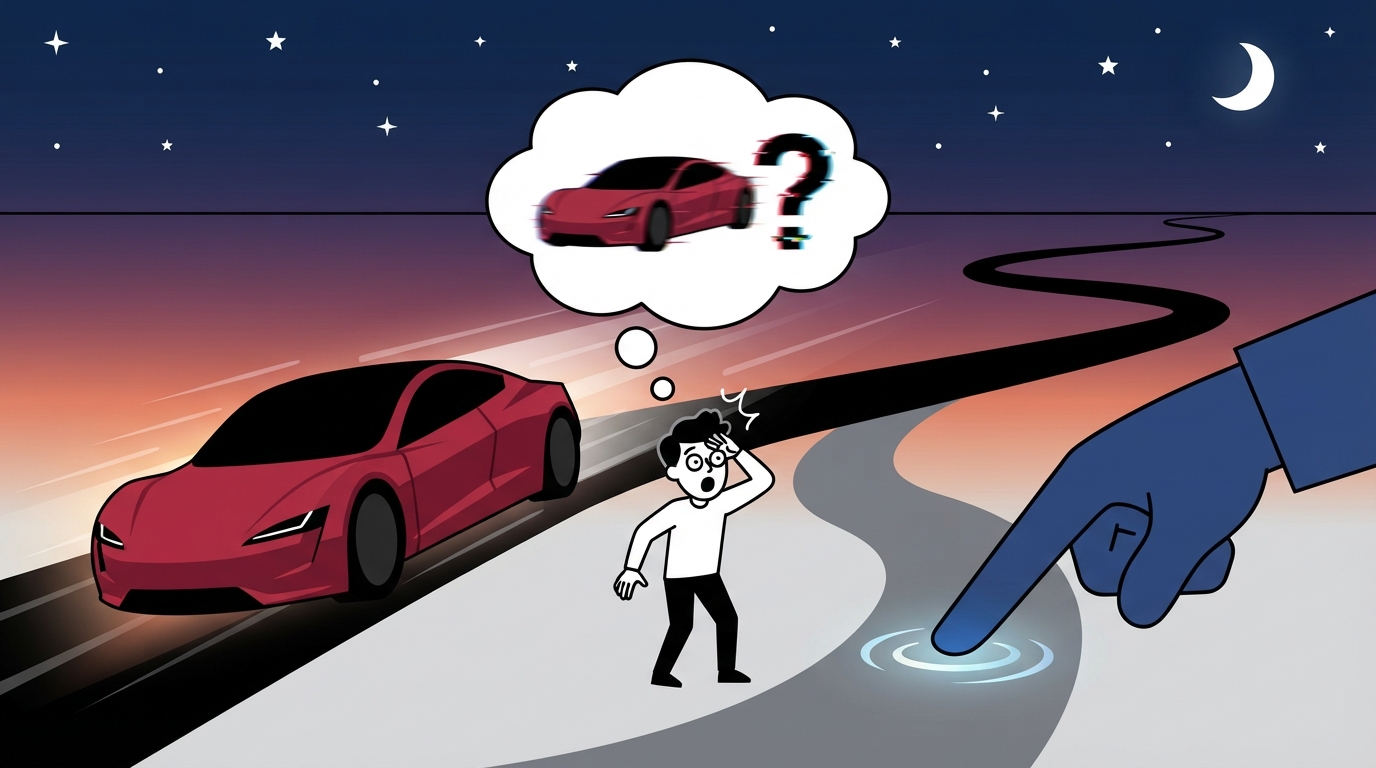
Hmm, some people in China, in order to win, would rather believe this is AI than believe it is a far-ahead technology transfer.
Roadster 2 had its concept car unveiled in 2017, but after delay after delay, in 2026 it finally delivered on the boast it had made.
The latest release has major changes in exterior design, seating layout, range metrics, and configuration tiers. Honestly, I think it isn't even worth comparing; it's simply a new car, and that's that. No need to agonize over it.
The following is based on first-hand information officially disclosed by Tesla and compiles detailed specs, technical implementation principles, pricing, delivery timing, and other content.
I. Versions and Specs
The full lineup consists of the base Performance model and two hardware augments: Thrust and Rocket. Nominal combined range for all exceeds 300 miles, about 483 km. Tesla has not yet announced EPA range breakdown data for each configuration.
Specific configurations are as follows:
Performance (Base Model)
- Official positioning: Road Ready, legal on public roads
- Seating layout: 2 seats
- 0–60 mph acceleration: less than 1.6 seconds, corresponding to 0–96 km/h
- Top speed: not separately announced
- Core aerodynamic and propulsion hardware: active aerodynamics package, paired with the Multi-Mode Suction System and Ground Sealing System
Thrust (Augment)
- Official positioning: Race Ready, track-level limited edition
- Seating layout: 2 seats
- 0–60 mph acceleration: less than 0.9 seconds; on-site measured demo was 0.81 seconds
- Top speed: not separately announced
- Core aerodynamic and propulsion hardware: adds 4 SpaceX cold-gas thrusters at the rear on top of the base hardware
Rocket (Augment)
- Official positioning: Air Ready; officially explicitly marked as not legal on public roads
- Seating layout: 1-seat single-seat layout
- 0–60 mph acceleration: less than 0.59 seconds
- Top speed: over 230 mph, about 370 km/h
- Core aerodynamic and propulsion hardware: adds 10 cold-gas thrusters around the body circumference on top of the base hardware, supporting forward thrust, vertical lift, and lateral reaction control
II. Body and Interior
- Extensive use of carbon fiber, magnesium alloy, and titanium alloy materials; the wheels use an ultra-thin-spoke lightweight design to achieve extreme weight reduction and free up space. The interior uses "fixed seat positions" and "manual mechanical controls"; in simple terms, it is built to sports car standards and currently cannot also deliver good comfort.
- Equipped with a yoke steering wheel supporting steer-by-wire, a central touchscreen, and two small instrument screens in front of the driver.
- The demo car's "Ano White" paint draws on rocket thermal protection coating technology; the window thermal insulation coating mimics the gold filter layer of a spacesuit visor.
III. SpaceX Cold-Gas Thrusters
This system does not burn rocket propellant to produce high-temperature exhaust gas; it is purely physical cold-gas propulsion.
All available voids inside the body (the Rocket configuration even occupies the passenger seat) are packed with SpaceX's "carbon-fiber-wrapped composite pressure vessels (COPV)" used on Falcon 9, to store extremely high-pressure compressed gas (air/nitrogen), with an onboard compressor provided for slow refilling.
When solenoid valves open, high-pressure gas is ejected at high speed through sea-level optimized De Laval nozzles, generating reaction thrust.
According to Tesla's official engineering notes, the thrust generated by its thruster system can reach "4–5 times" the limit of tire grip. The prototype demonstrated at the launch event had total thruster thrust exceeding 80 kN, equivalent to about 8.15 tons of thrust. This allows the vehicle to achieve extreme acceleration at the instant of launch without relying on tire-road engagement.
On the top-tier Rocket configuration, 10 thrust-vectoring / reaction control nozzles are arranged around the body. Downward firing can overcome gravity and briefly lift the vehicle off the ground, while lateral and forward nozzles are used for pitch and roll attitude stabilization in the air, as well as extreme braking on the ground and counteracting centrifugal force in corners.
Limited by the finite volume of the COPV tanks, high-intensity thrust can only operate in short pulsed bursts. Each launch or airborne jump rapidly consumes tank pressure; it cannot sustain long flight or unlimited consecutive launches, and must wait for the onboard compressor to repressurize or for external gas filling.
IV. Multi-Mode Suction System & Ground Sealing System
For use without thrusters or for everyday track driving, Roadster 2's underbody integrates a Ground Sealing System (sealing skirts) and high-power extraction fans.
Traditional aerodynamic packages must rely on extremely high vehicle speed to generate sufficient downforce, whereas the fan system can directly extract air from under the car "at standstill or low speed," creating a low-pressure zone beneath the chassis and using atmospheric pressure to pin the body firmly to the ground.
There are currently two modes:
- Low-Speed Suction Mode: seals the chassis edges and extracts air at full power, greatly increasing tire vertical load and mechanical grip for launches and low-speed corners. Tesla officially claims the system's ultimate suction force is even enough to let the vehicle "hang upside down from the ceiling" while stationary. When this was demonstrated, I was completely dumbfounded.
- High-Speed Airflow (Aero) Mode: when vehicle speed increases, the system opens front and rear underbody guide channels, allowing high-speed airflow to pass smoothly through underbody Venturi channels, reducing drag and converting it into high-speed aerodynamic downforce.
V. Optimus Actuator-Driven Active Aerodynamics
In Track Mode, the vehicle actively lowers suspension height and deploys a hidden active rear wing and spoilers. The drive motors for these aerodynamic surfaces directly reuse the high-torque Optimus actuators (linear and rotary) developed for the joints of Tesla's "Optimus humanoid robot." Tesla says the vehicle's overall downforce is "close to Formula 1 levels."
VI. Pricing and Reservation Policy
Neither Tesla's launch event nor official channels announced final retail prices; only reservation payment rules for each configuration were opened:
Performance
- Reservation payment: US50,000 total; an initial card payment of US5,000 is due immediately when placing the order, and the remaining US$45,000 must be paid within 10 days via wire transfer
- Purchase restriction: open to public reservations
Thrust
- Reservation payment: US250,000 total; an initial card payment of US5,000 is due immediately when placing the order, and the remaining US$245,000 must be paid within 10 days via wire transfer
- Purchase restriction: limited release, each customer limited to 1 unit, and subject to regional regulations
Rocket
Official invitation only; the official website has not disclosed the reservation payment amount or final price, nor has it explained specific invitation screening criteria or planned production volume.
In addition, for early owners who in 2017 already paid the full US$250,000 deposit to reserve the "Founders Series," Tesla has not yet disclosed clear rules in public terms on how this deposit will be converted or mapped under the new configuration system.
VII. Production and Delivery
Musk said at the launch event that it would be within 12–18 months after the event, essentially during 2027–2028.
But, at present there is no relevant information through official channels, and it's possible Musk is just running his mouth. Still, an actual car has already been demonstrated, so it shouldn't drag on for several more years, right?
I wanted to know all of the above myself, so I put together a summary and posted it along the way.
The rest—battery pack capacity, peak charging power, onboard compressor recharge time, and the public-road compliance certification status of the Thrust configuration in various countries—remains unknown. On compliance, it will probably take a while.